
As cyber threats grow in scale and sophistication, businesses face unprecedented challenges in safeguarding their digital assets. Traditional approaches to cybersecurity, while still vital, are no longer sufficient to counteract the dynamic and ever-evolving nature of cyberattacks. This reality has paved the way for artificial intelligence (AI) to emerge as a game-changer in the field of cybersecurity.
AI is revolutionising how organisations protect themselves, detect threats, and respond to incidents. By leveraging advanced analytics, machine learning, and real-time processing, AI-driven cybersecurity solutions provide the agility and foresight needed to stay ahead of sophisticated cyber threats. In this article, we explore the transformative impact of AI on cybersecurity and how Stellaxius is enabling businesses to adopt this innovation.
1. The Growing Importance of AI in Cybersecurity
In today’s interconnected world, cybersecurity has become a top priority for businesses of all sizes. The rapid digitisation of processes and exponential data growth have created a fertile ground for cyber threats to evolve and proliferate. Traditional security measures, while essential, often struggle to keep pace with the increasingly sophisticated nature of cyberattacks. These measures rely heavily on manual analysis and require security analysts to manually investigate and look for alerts, identifiable patterns, and other indicators of a potential security breach, which consumes a significant amount of time and has a higher margin of error.
This is where AI steps in. By harnessing the power of machine learning and advanced analytics, AI enables organisations to stay ahead of threat actors. As highlighted over the past years by Salesforce, including at Dreamforce, where the Salesforce Winter ’25 Release Notes were launched, trusted AI frameworks are essential for building systems that can dynamically adapt to emerging threats and maintain security in an ever-changing landscape. Especially because cyber threats have already evolved and invested in tools such as machine learning, artificial intelligence, and automation to create innovative tactics, including automated attacks, code generation, password cracking, and others, which increases the potential for incoming threats.
Using the same tools to both detect and manage threats enables a more effective response from security analysts, as they allow them to process a larger amount of data in less time, which increases not only efficiency but also productivity among cybersecurity teams.
For instance, organisations experiencing high volumes of login activity can leverage the Einstein Trust Layer and Salesforce Data Cloud to enhance anomaly detection. By continuously analysing login behaviour, the AI learns what constitutes standard user patterns and can quickly identify irregular or suspicious activity. When a deviation is detected, such as a user initiating a massive data export in the middle of the night from an unusual geographic location, the system flags it as a potential threat and automatically alerts the appropriate security teams in real-time.
The integration of AI in cybersecurity is no longer a luxury—it is a necessity. With cyberattacks causing billions of dollars in damages annually, companies need intelligent solutions that can proactively identify and mitigate risks in real-time.
2. Enhancing Threat Detection, Incident Response, and Security Posture with AI
AI transforms the way organisations approach threat detection, incident response, and overall security posture:
Threat Detection: AI-powered systems can process vast amounts of data, identifying patterns and anomalies that indicate potential threats. AI can detect even subtle deviations in behaviour that would go unnoticed by traditional methods.
Incident Response: Speed is critical in addressing cyber threats, and AI accelerates response times by automating threat analysis and providing actionable insights to security teams. For example, Salesforce’s AI solutions use predictive models to preventively block potential attacks, reducing the time needed to neutralise risks.
Improving Security Posture: AI doesn’t just react; it helps organisations build stronger defences by continuously learning from past incidents. This iterative improvement ensures that security systems remain robust and adaptive against new vulnerabilities.
3. Applications of AI in Cybersecurity: Practical Examples of Einstein Trust Layer
The practical applications of AI in cybersecurity demonstrate its transformative potential, particularly with tools like Salesforce’s Einstein Trust Layer, which ensures the ethical and effective deployment of AI.
The Einstein Trust Layer is a foundational component of Salesforce’s AI ecosystem, designed to ensure that artificial intelligence is not only powerful but also ethical, secure, and transparent. It provides advanced security mechanisms, maintains data integrity, and ensures that AI-driven decisions are explainable and reliable. Salesforce built the Einstein Trust Layer to address growing concerns around data privacy, ethical AI deployment, and regulatory compliance. It empowers organisations to harness AI’s potential without compromising on trust or control through:
Anomaly Detection: Einstein Trust Layer integrates AI algorithms that monitor user behaviours and network traffic to identify unusual patterns. By leveraging real-time data from Salesforce Data Cloud, the system can flag activities deviating from established norms, enabling organisations to address threats before they escalate.
Intrusion Detection: With AI-driven insights, the Einstein Trust Layer bolsters traditional intrusion detection systems by analysing vast datasets to pinpoint unauthorised access attempts. This proactive approach minimises vulnerabilities and reduces the risk of data breaches.
Threat Intelligence: Salesforce’s AI provides advanced threat modelling capabilities. By utilising predictive analytics and data from global threat intelligence sources, Einstein Trust Layer delivers actionable insights, empowering organisations to anticipate and mitigate emerging cyber threats.
Enhanced Transparency and Control: A key feature of Einstein Trust Layer is its focus on transparency, ensuring organisations understand how AI-driven decisions are made. This fosters trust in AI systems while maintaining compliance with regulatory standards.
The following diagram illustrates how the Einstein Trust Layer processes customer data:
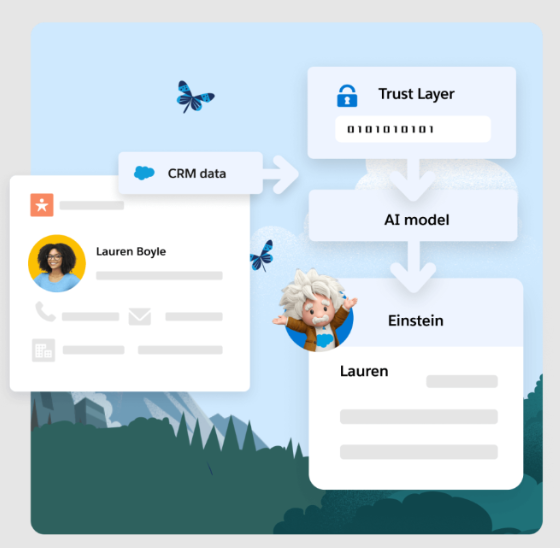
As shown in the image, CRM data (such as customer information) first flows through the Trust Layer, where it is safeguarded using encryption, access controls, and data masking. From there, the secured data is passed to the AI model, ensuring that only necessary information is used to generate responses. Salesforce Einstein then uses this refined input to deliver personalised, actionable insights, like identifying a customer by name, while maintaining compliance with strict regulations such as GDPR and CCPA. Organisations can customise AI functionalities to align with their specific needs, fostering accountability and trust in AI-driven operations.
Salesforce’s trusted AI framework ensures the ethical and effective implementation of AI in cybersecurity, enabling businesses to defend against threats while maintaining data privacy (Salesforce).
4. The Benefits and Stellaxius’ Role in AI-Powered Cybersecurity
The benefits of AI in cybersecurity are clear: improved threat detection, faster incident response, and a more robust security posture. Organisations that embrace AI-driven security solutions are better equipped to navigate the complexities of today’s digital landscape.
At Stellaxius, we recognise the transformative potential of AI in cybersecurity. By combining our expertise in Salesforce solutions with cutting-edge AI technologies, we empower businesses to build proactive, secure environments. Our tailored approach ensures that each client benefits from solutions designed to address their unique challenges, enabling them to thrive in a secure digital world.
Together, we can redefine cybersecurity and build a safer, smarter future. Contact us!

I hold a Bachelor’s and Master’s degree in Computer Engineering and my goal is to improve and simplify people’s lives through the development of digital products and solutions. Currently, I work as a Salesforce Developer at Stellaxius, where I am focused on growing my expertise and building my career in this technology.