
Most companies face a common and costly challenge today: too much customer data spread across numerous disconnected tools.
With information stored in separate tools and channels, it becomes challenging to create a truly personalised experience for each customer. Email platforms, social media channels, CRMs, analytics dashboards – when data lives in silos, marketers struggle to build a complete picture of the customer. The result? Generic campaigns, missed opportunities, and poor customer experiences.
Unify Data and Automate with Salesforce Marketing Cloud Next
To overcome this fragmentation, marketers need a platform that centralises data, connects channels, and automates personalisation.
Salesforce Marketing Cloud Next does exactly that, combining CRM and marketing in one unified solution.
Built natively on Salesforce’s core CRM and powered by Data Cloud, MCN brings together marketing, sales, service, and commerce data into a single, real-time customer profile. This enables smarter decisions, faster execution, and more relevant engagement.
Marketing Cloud Engagement vs. Marketing Cloud Account Engagement
Within the Salesforce portfolio, there have been, until now, two leading solutions for marketing:
- Marketing Cloud Engagement (MCE): This is Salesforce’s original solution for B2C marketing. It allows brands to create automated, personalised journeys across multiple channels, such as email and SMS. Traditionally, MCE operates on its own infrastructure and is built to handle large-scale marketing activities, supporting high volumes of customer interactions and engagement. To find out more about MCE’s features, take a look at our article on the Top Salesforce Spring ’25 features.
- Marketing Cloud Account Engagement (MCAE): This is the evolved version of Pardot, created with B2B marketing in mind. It’s built to handle longer, more complex sales cycles and connects directly with Salesforce sales data, like leads, contacts and campaigns. This makes it easier to automate lead nurturing and scoring, while keeping marketing and sales teams working in sync.
In summary, MCE focuses on mass campaigns and multiple channels for end consumers, while MCAE focuses on marketing and sales alignment in B2B scenarios. If you want to learn more about how to choose the right tool, you can check our article about Marketing Cloud and Pardot.
While both are powerful, they operate on separate infrastructures, adding to the fragmentation problem.
What is Marketing Cloud Next?
Marketing Cloud Next (MCN) is the new generation of Salesforce’s Marketing Cloud. It was designed to simplify everything that was previously spread across multiple solutions and bring it all together in one place, directly into the Salesforce core CRM.
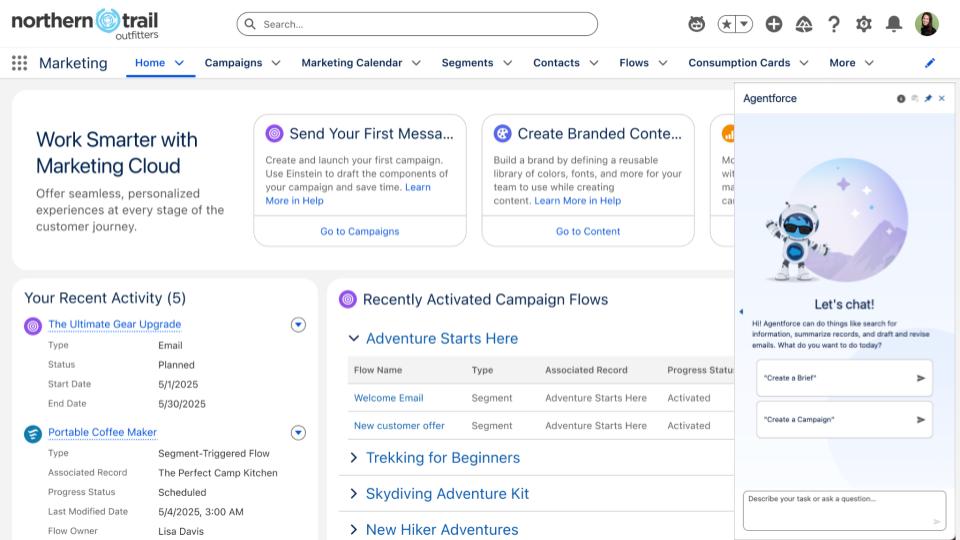
What is new in Marketing Cloud Next?
The most notable capabilities of Marketing Cloud Next lie in:
- Agentic marketing: Marketing Cloud Next introduces Agentforce-style agents that can create campaigns, draft copy, decide next-best actions and turn “do-not-reply” channels into two-way, agentic engagements. Plus, new AI decision elements (e.g., “Einstein Decision”) let flows/journeys use models like engagement scoring to route customers dynamically, resulting in less manual branching and more automated personalisation.
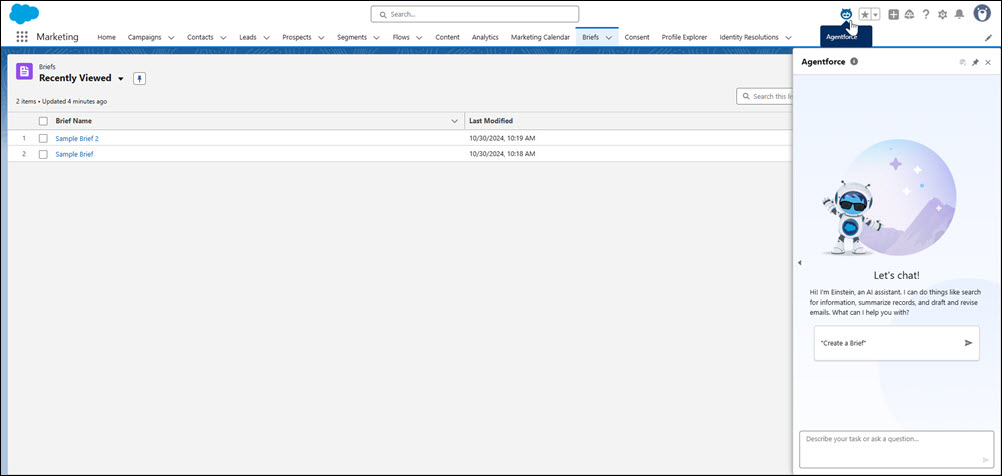
- Built natively on Data Cloud: Instead of separate marketing data silos, MCN runs on Data Cloud, so marketers get shared, real-time customer profiles across Sales, Service, Commerce and Marketing.
- Unified System: Content creation and campaign builders are being consolidated (Salesforce CMS + new builders), allowing email, forms, landing pages, and content reuse to occur in the same place.
- Editions/Licenses: Marketing Cloud Growth and Advanced licenses are the first MCN offerings; Salesforce is positioning them alongside legacy Marketing Cloud products during the transition rather than as an immediate cut-over.
Why are Those Changes Important?
- Faster time to campaign: Generative agents, combined with unified data, enable teams to create and launch with fewer handoffs.
- Better personalisation at scale: Data Cloud + Einstein decisioning provides more accurate, real-time next-best actions.
- Lower integration overhead: Fewer custom connectors and sync jobs because MCN runs on the Salesforce core.
Marketing Cloud Next Editions
MCN comes in two main versions:
- Growth Edition: Ideal for those who want to grow their marketing in an organised way. Includes multi-channel campaign management, basic performance dashboards, and dynamic audience segmentation.
- Advanced Edition: Everything Growth has, plus AI features, experimentation, and in-depth analysis. This version is recommended for sophisticated marketing operations that aim to be fully automated.
In both editions, the experience is native to CRM, meaning that everything the customer does is fed directly into the platform, providing a complete and up-to-date view.
FedEx Case Study
Challenge:
FedEx had vast amounts of customer data spread across disconnected systems, including sales, shipping, and web platforms. This fragmentation made it difficult to act on customer signals and personalise engagement.
Solution:
Using Salesforce Data Cloud and Marketing Cloud, FedEx unified its data in real time. This enabled AI-driven personalisation and reactivation of dormant accounts.
Results:
- +2,000% ROI
- 13% improvement in customer activation
- 1 billion personalised emails sent annually
Let’s Solve Data Fragmentation Together
Investing in Salesforce Marketing Cloud Next is more than a tech upgrade.
It’s a strategic move toward data-driven, AI-powered marketing. But unlocking its full potential requires more than just implementation.
At Stellaxius, we go beyond configuration. Our Advisory Services combine deep Salesforce expertise with strategic marketing insight to help you:
- Diagnose your data fragmentation challenges
- Design a unified marketing architecture
- Implement Marketing Cloud Next with precision
- Activate AI-driven personalisation at scale
- Ensure long-term success through tailored enablement and optimisation
Whether you’re starting fresh or transitioning from legacy tools, our team is ready to guide you every step of the way.
Ready to unify your data and elevate your marketing strategy?
Contact Stellaxius today and discover how we can help your business grow with the power of Salesforce Marketing Cloud Next.

I'm currently a Salesforce Consultant at Stellaxius, specialising in Data & Analytics and working as a Business Analyst. I'm a motivated and detail-oriented professional with a strong commitment to continuous learning and personal growth. In my role, I collaborate closely with stakeholders to understand their needs, support data-driven decision-making, and ensure that the solutions we deliver align with strategic business goals.