
The autonomous enterprise: are you overlooking the blind spot?
Boardroom discussions across every industry are shifting from AI model selection to operational deployment. Yet, when enterprise agentification projects stall during proof-of-concept, the model is rarely at fault. The major bottleneck is that legacy integration infrastructure is built for human operators and rigid rules, rather than autonomous digital workers making dynamic, real-time decisions.
The 2026 MuleSoft Connectivity Benchmark (1,050 IT decision-makers surveyed globally) provides definitive market evidence regarding legacy integration constraints and their direct impact on AI success:
- 96% of IT leaders agree that the success of AI agents depends directly on modern integration;
- 82% of IT leaders cite legacy integration as their most significant AI hurdle;
- 46% of enterprises operate their autonomous tools in the absence of a centralised management system;
- 42% represents the current average enterprise asset reuse rate, which continues to decline due to the proliferation of custom builds.
Bridging this gap requires moving beyond legacy connectivity. Without an Agent-Aware Integration Architecture (AAIA), enterprises inevitably encounter hidden operational bottlenecks.
What are the risks of deploying AI Agents on legacy infrastructure?
Ensuring a successful transition to autonomous operations requires a detailed understanding of the three major risks associated with outdated connectivity models.
1.The API discoverability issues caused by human-centric interface barriers
Traditional integration assets were designed for human operators who navigate application interfaces and interpret data fields manually, or software systems that execute fixed, pre-coded rules. An AI agent represents a fundamentally new class of consumer because it operates on non-deterministic principles, making dynamic, real-time decisions about which API to call, how to interpret the payload, and what action to execute next. For an autonomous agent to perform these tasks successfully, the underlying integration layer must be discoverable, interpretable, and self-documenting.
Traditional API registries present a significant discoverability barrier. These APIs are documented in external repositories, formatted in inconsistent styles, and labelled with cryptic technical shorthand that requires human context to decipher. A human developer easily resolves an undocumented or cryptically named API endpoint by consulting a colleague or reviewing a PDF manual, whereas an autonomous agent requires machine-readable precision to interpret the purpose, constraints, field semantics, and side effects of an API.
Your integration layer must describe itself clearly to an autonomous system to prevent your AI agents from remaining idle. By optimising API discovery through MuleSoft, your IT teams are empowered to publish integration assets as self-describing, machine-readable products, ensuring that agents can independently locate, understand, and consume enterprise capabilities safely.
2. “Confidently wrong” executions
When a human analyst encounters messy, duplicate, or conflicting data, they notice. They pause, verify, and ask questions. But when an AI agent encounters unvalidated data (duplicate customer IDs, mismatched operational fields, or outdated prices), it reasons with the available information and produces a highly confident, but completely incorrect, output.
“An agent reasoning over wrong data does not produce a slightly wrong answer. It produces a confidently wrong one, and at machine speed.” Gustavo Leitão, Integration Practice Lead at Stellaxius, in our whitepaper Agent-Aware Integration Architecture.
An agent reasoning over wrong data does not produce a slightly wrong answer. It executes a cascade of wrong downstream transactions before anyone realises something has gone wrong.
This severe operational risk is particularly evident within the Telecommunications industry, where customer data is historically fragmented across legacy billing systems, network databases, and Customer Relationship Management (CRM) software. When deploying an AI agent to automate billing disputes or plan changes, its effectiveness depends entirely on data consistency. If the agent retrieves an outdated contract rate or applies an incorrect service tariff, it will process a legally compliant transaction that is financially disastrous.
To prevent these automated errors, enterprises must establish an architectural safety gate that cleanses, deduplicates, and resolves customer data before any AI model is permitted to interact with it.
3.Uncontrolled execution: compute inflation and audit exposure
When it comes to autonomous deployment, unifying data and ensuring its quality represents only a partial solution to the broader challenges.
As companies move from small tests to full-scale use, managing the costs and risks of AI agents becomes a top priority. When agents operate in silos, two major risks arise:
a. The agents use computing power and token allowances with every action they take, leading to unexpected costs if not controlled.
b. In highly regulated industries, every decision made by an agent must be fully traceable to meet legal and audit standards.
For example, if an agent approves a credit change or updates a customer record, the company needs a complete record showing which data was used, which tools were called, and the reasoning behind the decision.
In sectors like Finance, Consumer Goods, and Telecom, having proper governance for AI agents in systems like Salesforce and a single control system is essential for staying compliant. Managing this risk requires a unified platform that tracks all agents, sets strict budget limits, and keeps detailed records of everything they do. Building an Agent-Aware Integration Architecture is the most effective way to connect traditional middleware with autonomous systems.
Agent-Aware Integration in practice: Consumer Goods
The real-world effectiveness of an AAIA framework becomes apparent when you look at how autonomous workflows function in complex business settings. Take the Consumer Goods industry, for example. Running autonomous digital workers here needs smooth data sharing between the front office, where customer interactions happen, and the back office, which manages supply chains.
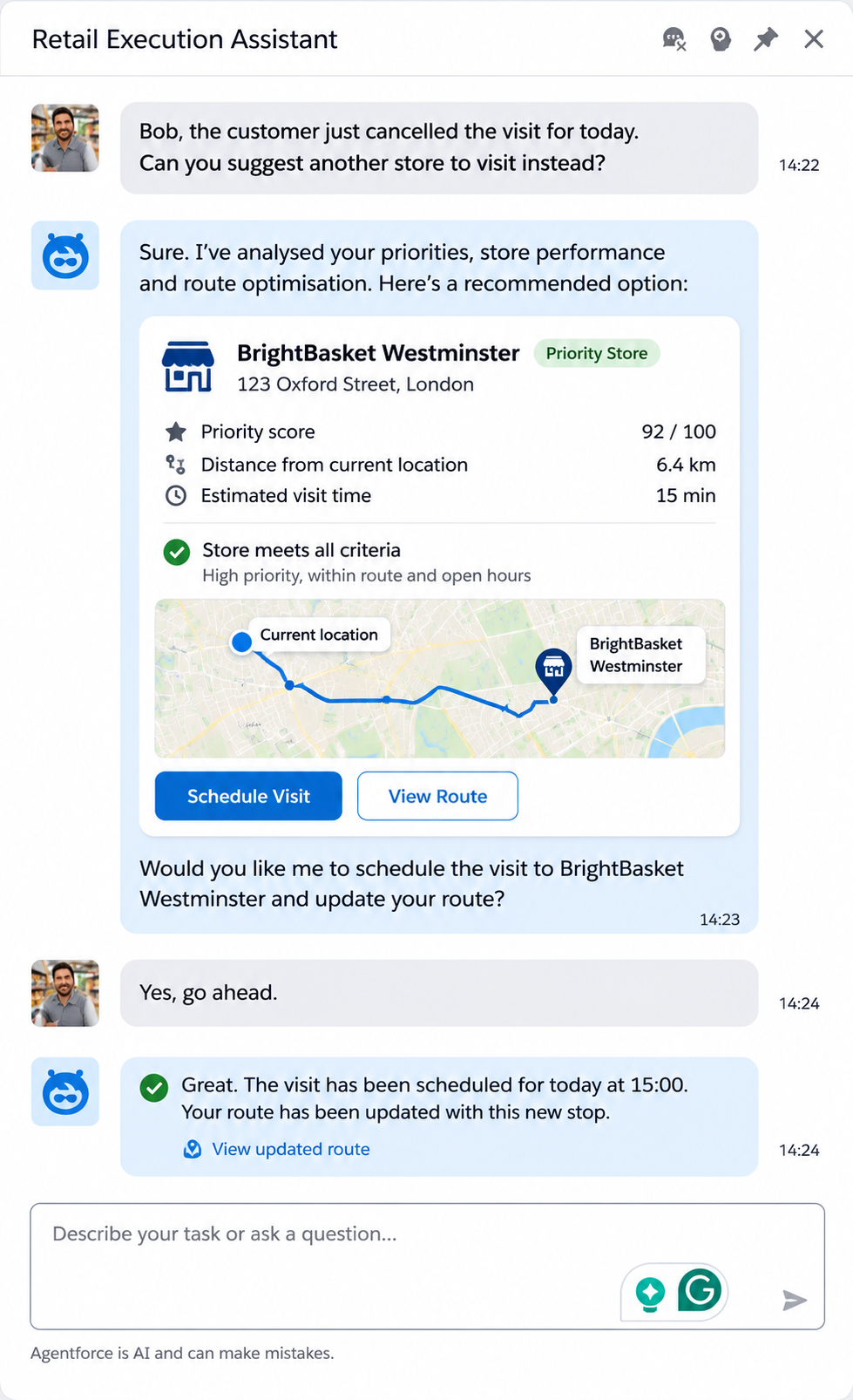
When Falua, a well-known wine producer, began its digital transformation, it set up clear customer groupings and flexible sales territory plans using Salesforce Consumer Goods Cloud (now Agentforce Consumer Goods). To improve these retail processes further with autonomous AI agents, it’s essential to have strong data preparedness. If a client cancels a meeting, an AI scheduling agent can’t just recommend another store to visit. It must quickly check priority stores, route optimisation and other pre-set criteria, cross-checking ERP and CRM data.
This level of autonomous coordination demonstrates that deploying effective AI workers is never solely about the reasoning model, relying instead on a connected ecosystem where every core system communicates reliably in real time. Without this integrated foundation, even the most sophisticated agents remain confined to basic suggestions rather than executing trusted business actions.
But moving from isolated pilots to this level of operational agility requires a clear understanding of your current system readiness and integration maturity.
How to establish an Agent-Aware Integration Architecture?
Stellaxius’ Agent-Aware Integration Architecture acts as a modular and expandable model that keeps and improves your current IT systems. It organises connectivity into five specific functional layers, moving step by step from your integration base to the governance of active agent runtime.
Autonomous agents require infrastructure built specifically for machine reasoning, reliable API discovery, and deterministic safety paths.
To examine how your existing middleware can safely host autonomous digital workers, download the Stellaxius’ Agent-Aware Integration Architecture Whitepaper and explore the complete blueprint, protocol standards, and data readiness gates.
Download the complete Stellaxius Agent-Aware Integration Architecture Whitepaper to examine our detailed five-layer reference architecture, protocol specifications, and data readiness gates.
How can your organisation prepare for the Agentic enterprise?
Transitioning from isolated AI pilots to a fully agentic enterprise requires evolving your middleware from passive connectivity into an active, machine-readable ecosystem. As a specialised Salesforce and MuleSoft Partner, Stellaxius bridges the gap between legacy enterprise architectures and modern autonomous workflows.
We help technology leaders modernise their integration landscape—preserving existing middleware investments while embedding the data safety gates, protocol bridges, and central governance required for tools like Salesforce Agentforce and custom AI engines.
Stellaxius supports your transformation through two structured, high-impact engagements:
- Agentic Integration Readiness Assessment (2–4 Weeks)
A comprehensive evaluation of your current API discoverability, data quality maturity, and security posture. We map your system touchpoints against our five-layer framework and deliver a clear, prioritised architectural roadmap.
- Agent-Aware Framework Design & Implementation (4–8 Weeks)
End-to-end architecture co-design and deployment. We configure your Master Data Management (MDM) golden spine, establish Model Context Protocol (MCP) bridges across MuleSoft and Salesforce Data Cloud, and implement unified control planes for complete token cost monitoring and auditability.
Ready to take the next step?
Contact us and book a meeting to discuss what you need to do to get your systems ready for the Agentic era.

Passionate for technology and innovation, I’m a solution architect, a solution provider and I aim to be a trusted advisor. I try to learn something new every day and I’ll share it here with you every now and then.