

How is the transition to Headless architecture reshaping enterprise value?
Sitting in the main keynote at Dreamforce 2026, I witnessed the official unveiling of Salesforce AIforce, which establishes a formal platform architecture for the autonomous enterprise. In our previous analysis on Claudeforce, we demonstrated the operational benefits achieved when an enterprise platform permits users to access trusted data, workflows, and actions directly through external interfaces like Claude. Salesforce has now formalised this broader strategy, ensuring that enterprise capabilities accompany users and autonomous digital workers into whichever digital environment they choose to work.
My immediate reaction during the keynote was that AIforce represents much more than a routine product announcement. It is Salesforce acknowledging that the next era of enterprise software will not be defined by who owns the application screen, but by who owns the trusted business context, the business logic, the agentic execution layer, and the governance framework that AI interfaces depend upon.
As organisations expand AI adoption, technology leaders face an increasingly complex challenge. Businesses want access to trusted data, workflows and actions across multiple interfaces, while still maintaining governance, security, permissions and auditability. In my view, AIforce reinforces a broader industry shift: enterprise software is becoming less about owning the application screen and more about owning the trusted business context, logic and execution that AI experiences depend on.
How do Salesforce platform layers support a Headless enterprise architecture?
Salesforce describes AIforce as a live interface layer that brings Salesforce data, workflows, business logic, semantics, permissions, security, and governance directly to any AI interface. People no longer need to navigate directly to Salesforce screens to complete routine tasks, because Salesforce capabilities can come directly to them in Claude, Slack, Lightning, or custom front-end applications.
How Salesforce structures its platform layers clarifies this fundamental shift from static destination applications to trusted execution platforms:
1. AIforce (Live Interface Layer): Makes platform capabilities accessible across any digital workspace, including Claude, Slack, Lightning, and custom frontends;
2. Agentforce (Digital Workforce Layer): Provides the agentic reasoning, orchestration, and autonomous execution layer across enterprise workflows;
3. Customer 360 (Apps and Workflow Intelligence Layer): Contains the core business processes, rules, and semantics that power sales, service, marketing, and commerce operations;
4. Data 360 (Integration and Harmonisation Layer): Establishes the trusted data spine across structured and unstructured enterprise Information Technology (IT) assets;
5. Headless Toolkit (Developer Foundation Layer): Forms the foundational technical layer that exposes enterprise capabilities safely through Application Programming Interfaces (APIs), the Model Context Protocol (MCP), and Command Line Interface (CLI) tools.
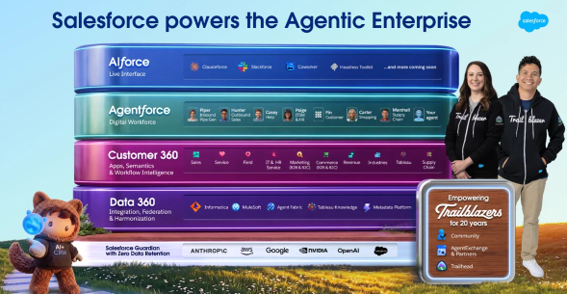
Salesforce Dreamforce 2026 5-Layer Platform Architecture
Why is platform engagement moving beyond traditional application logins?
During the Dreamforce keynote, Salesforce President for Applications and Marketing, Patrick Stokes, referenced a provocative question regarding platform adoption:
Why should you log into Salesforce ever again? Maybe you never will.
At first reading, this statement sounds almost paradoxical coming from the leadership of a global enterprise software provider. But the explanation resides in the fact that Salesforce is redefining what platform adoption and engagement mean for technology decisionmakers.
Having been involved in numerous Salesforce implementations over the years, I have traditionally seen platform adoption measured through user logins, screen usage, record updates, and the number of employees actively navigating application menus. In a headless, agent-driven enterprise, those traditional metrics become secondary. A sales representative interacts with Claude, a customer service representative works through Slack, and an executive consumes operational insights through a dynamically generated interface. The underlying platform delivers the data, business rules, workflow execution, permissions, and governance behind every interaction while reducing dependency on native screens.
In my view, traditional adoption metrics such as login volume become less meaningful in a headless, agent-driven enterprise. Technology leaders should instead focus on how trusted business capabilities can be consumed across different environments.
1. How to deliver Salesforce context and actions directly into the workspaces where users and digital workers prefer to operate;
2. Which business capabilities to publish as reusable tools across Salesforce, Slack, Claude, Microsoft Teams, and custom AI runtimes;
3. How to enforce consistent security permissions, data controls, and auditability across every human and agent interface.
This is why the Headless approach and Model Context Protocol matter. Salesforce states that AIforce makes platform capabilities accessible through APIs, MCP and CLI tools, meaning the same capability can be invoked across different human and agent experiences while maintaining trust.
How does AIforce reframe the role of Agentforce?
In our Claudeforce blog post, we discussed whether Claudeforce redefined Agentforce or made it more important than ever. The conclusion was that Claudeforce changed where users could interact with AI, while Agentforce remained the layer where organisations define how AI should operate.
AIforce makes this distinction even clearer. Rather than competing with Agentforce, it expands the environments in which Salesforce-powered experiences can be delivered, while Agentforce defines the agents, reasoning, actions and workflows that operate within those experiences.
The introduction of AIforce reinforces the strategic role of Agentforce agentic execution. AIforce operates as a complementary interface layer rather than a replacement for agent reasoning:
- AIforce expands where Salesforce-powered experiences can happen;
- Agentforce defines the digital workers, reasoning logic, workflows, and autonomous actions that operate within those experiences.
Although industry discussions have placed substantial emphasis on AI as a conversational interface, AIforce positions Agentforce firmly within the real agentic execution layer that supports experiences across Salesforce, Slack, Claude, and custom assistants. For this reason, operating in the AIforce era introduces a vital strategic requirement: technology leaders must distinguish between commodity utility skills and differentiated business agents.
Which strategic imperatives should be prioritised in the Headless Era?
By observing enterprise deployments in the AIforce era, I would highlight three critical execution imperatives for Centre of Excellence (CoE) leaders and technology decisionmakers:
- Integration architecture serves as the decisive scaling facto: As the number of AI interfaces increases, each digital worker requires secure access to enterprise systems. Implementing MCP MuleSoft capabilities and MuleSoft Fabric allows organisations to expose reusable, governed business capabilities across Salesforce and third-party systems safely;
- Change management must focus on task delegation and supervision: User enablement should evolve toward teaching teams how to delegate tasks to agents, validate decision outputs, and supervise autonomous execution quality across daily operations;
- Governance should be engineered directly into system architecture: Governance must be engineered directly into system architecture. When an AI interface can query data, update records and trigger workflows, permissions, auditability and data governance cannot be added later. They must be designed into the architecture from the beginning.
How can Stellaxius guide your organisation through the transition to Headless AI?
At Stellaxius, we connect business vision and technology strategy through practical advisory engagements that unite AI, integration, and data, keeping Salesforce at the core.
The AIforce announcement makes a well-defined Enterprise AI Strategy and Roadmap an immediate operational priority. Technology leaders must determine which experiences should remain inside Salesforce, which capabilities should be published across external interfaces, how Agentforce fits into the broader enterprise landscape, and how governance should operate across every touchpoint.
Stellaxius’ commitment to transparency, teamwork, responsibility, and customer satisfaction ensures that every architecture recommendation delivers measurable business value. For organisations managing complex technology stacks, an Agentic Integration Readiness Assessment identifies the clear architectural steps required to scale AI initiatives securely. From there, an actionable transformation roadmap connects system architecture, implementation, change management, and team enablement to deliver long-term satisfaction.
Contact us now and evaluate your organisation’s system readiness and AI strategy through a consultative alignment meeting with our integration specialists.

At Stellaxius, I lead the evolution of our AI offering and advisory framework, from defining our internal and external AI strategy to helping customers assess their readiness and turn AI roadmaps into business value.