

Can AI agents in customer service build loyalty rather than just cut costs?
Businesses invest in chatbots, ticket routing systems, and self-service portals to reduce pressure on support teams and improve operational efficiency.
In theory, customers benefited from faster responses while organisations lowered service costs.
In practice, many automation initiatives created frustration instead of loyalty.
Customers became trapped in rigid workflows, bounced between channels, or forced to repeat information multiple times before reaching a resolution. The technology may have reduced ticket volumes, but it often increased customer effort and weakened trust.
That is why the conversation around AI agent’s customer service is changing. Forward-thinking organisations are no longer treating automation as a support function alone. They are treating it as a loyalty strategy.
Today’s AI agents can understand context, resolving complex issues, predicting customer needs, and supporting service teams in ways that directly influence retention, satisfaction, and long-term customer value.
Demo: Salesforce Service Agent in Practice
In this demo, we show a scenario when a client receives an email to create an IP address as part of a telecom service setup. Since the agent may lack technical knowledge (e.g., IPv4 vs IPv6), they would normally depend on a technical team.
With the intelligent agent, users get real-time guidance through Knowledge Articles and Data Cloud, enabling them to complete tasks independently, faster, without needing to escalate.
Salesforce Employee Agent in Practice: 2 Use Cases
Employee Agent: Knowledge Agent
In my experience as a Salesforce Consultant, the examples below show four key areas where Agentforce really helps improve service quality, make better use of knowledge, and boost how efficiently things run:
1. Salesforce Documentation: Step-by-Step Guided Support
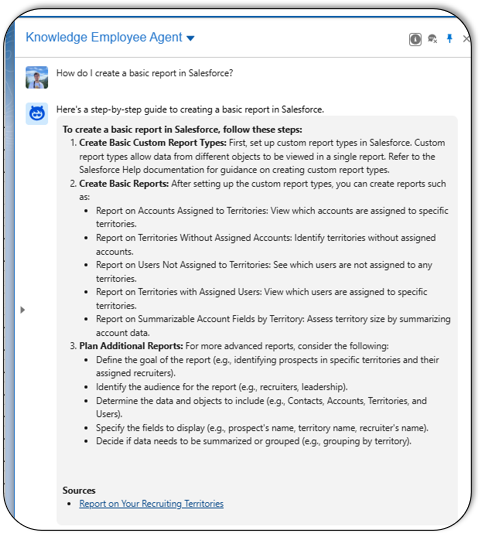
When a user asks how to create a basic report in Salesforce, the Agentforce agent doesn’t just point to documentation.
It delivers a structured, step-by-step response covering custom report types, account and territory assignments, and planning additional reports. The agent references Salesforce Help documentation as a source, enabling service teams and end users to resolve technical questions without escalation.
This capability is particularly valuable for organisations onboarding new users or managing large Salesforce deployments across multiple teams.
2. Web and Knowledge Article Integration: Grounded, Verifiable Answers
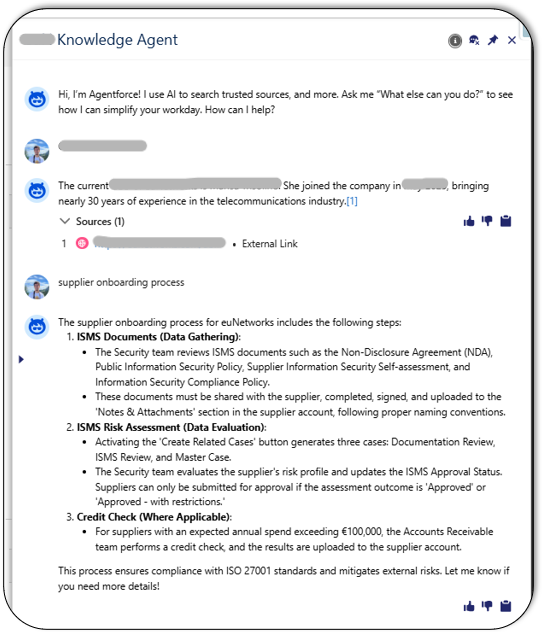
Agentforce can surface accurate, source-cited answers by searching both internal knowledge bases and trusted external links simultaneously.
For example, when asked about a supplier onboarding process, the agent retrieved and synthesised relevant content from ISMS documentation, risk assessment procedures, and credit check workflows, presenting it in a clear, structured format with cited sources. This reduces agent handling time, improves answer accuracy, and ensures compliance with documented processes.
Our Telecom Client’s Personalised Agent
1. Handling Knowledge Gaps with Transparency
A critical differentiator of well-designed Agentforce agents is how they respond when internal knowledge is incomplete.
When asked to explain the sales process at one of our telecommunications clients, the agent transparently acknowledged the gap, outlined what could be shared from internal documentation, referenced relevant external sources about the organisation, and directed the customer to the appropriate internal team.
This behaviour builds trust rather than eroding it, preventing agents from fabricating answers and ensuring customers receive honest, actionable guidance even when full information is unavailable.
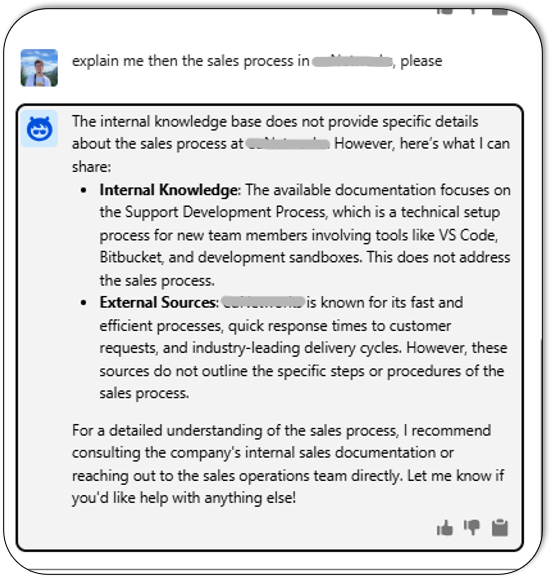
Figure 3 – How Agentforce responds when there are no knowledge articles
2. Structured, Clear Responses Linked to CRM Records
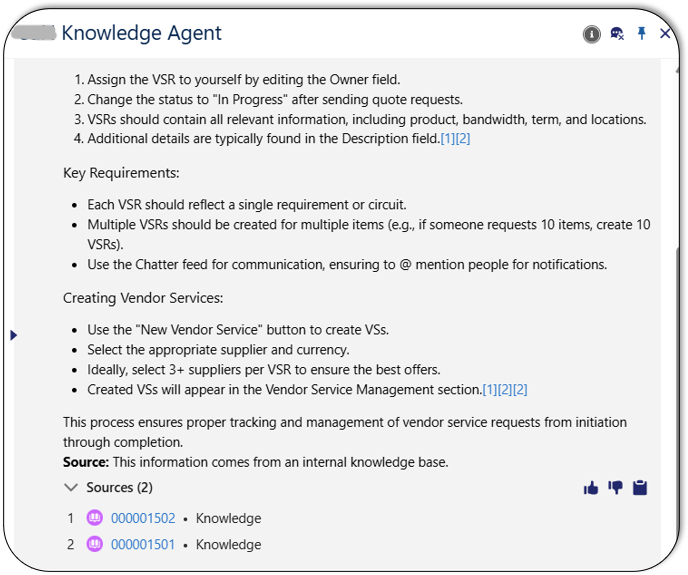
The fourth example illustrates how Agentforce agents can deliver highly structured operational guidance tied directly to live Salesforce records.
When queried about Vendor Service Requests (VSRs), Agentforce provides a clear, numbered workflow covering ownership assignment, status management, key requirements for creating multiple VSRs, and Chatter usage for notifications.
The response was grounded in two specific Knowledge records cited by record ID, demonstrating full traceability. This capability enables service teams to act consistently, reduce errors, and maintain audit trails, all without leaving the CRM environment.
Together, these four capability patterns represent the practical value of Agentforce deployed within Salesforce environments.
They move far beyond scripted automation, operating as intelligent assistants that ground answers in verifiable data, handle ambiguity gracefully, and support both customer-facing and internal service teams with consistent, high-quality responses.
Employee Agent: NOC Agent
This NOC Agent is a productivity multiplier. By leveraging customised features and specialised prompts, it tackles the “boring” yet necessary tasks that consume your day.
Key Benefits:
- Time Recovery: Automates routine ticket updates and status reporting.
- Consistency: Ensures high-quality documentation through standardized prompts.
- Focus: Frees up specialists to handle complex troubleshooting and infrastructure stability.
The goal is simple: eliminate the friction of manual tasks so our engineers can do what they do best keeping the network running at peak performance.”
By integrating these smart features directly into Salesforce, we are transforming the way the NOC team interacts with data, moving from manual processing to intelligent orchestration.
Below are a few examples of features added to the NOC Agent, demonstrating the ‘Before vs. After’ use cases in simple terms.
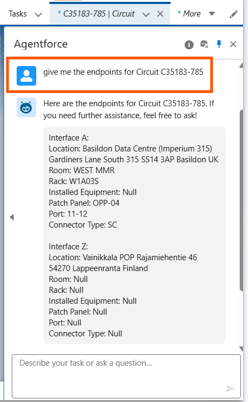
Feature 1: Get endpoint information directly from Agentforce:
Before – The users need to click in different records to get all the information that they need to send the FLM Dispatch.
Now – The users can ask the Agent to get the endpoints for one or more circuits at once. Will take just a few seconds.
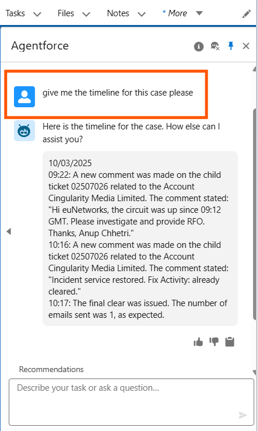
Feature 2: Get case timeline directly from Agentforce:
Before – The users need to edit manually the timeline in the RFO Document
Now – The Users can ask the Agent the correct timeline for the RFO Document and just need to copy and paste.
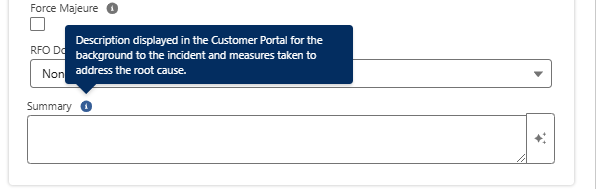
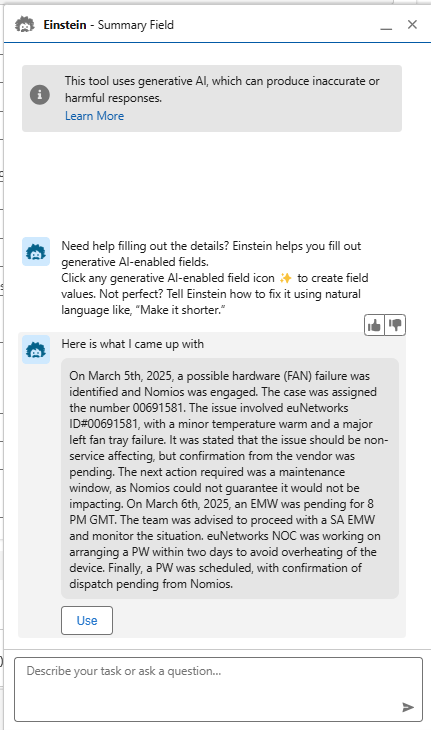
Feature 3: Quickly write case summaries
Before – The users need to populate a field named “Summary” manually or read all the Emails of a Case.
Now – The Users can click on the AI button of the field “Summary”, and the Agent will generate all the text for that field automatically and populate it. In terms of the emails, the user can just ask the Agent to summarise all the Emails of the Case.
The Loyalty Connection
One of the biggest misconceptions surrounding service automation loyalty strategies is the belief that customers only care about the outcome.
The experience of reaching that outcome matters just as much. Even when an issue is eventually resolved, a frustrating or time-consuming process can still damage trust and weaken the customer relationship. This is why organisations are placing greater emphasis on metrics such as customer effort score alongside traditional KPIs like CSAT and NPS.
Many organisations understand the potential of AI-driven service transformation.
But enterprise service environments are complex and customer data is often fragmented across platforms. Service processes evolve over time. Teams operate across multiple regions and channels. Legacy systems create integration challenges.
Simply deploying AI tools does not automatically improve customer experience.Without a blueprint, building automation is like adding rooms to a house without hallways—it creates a confusing maze instead of a functional home.
This is where Stellaxius provides value.
Rather than approaching AI as a standalone technology purchase, Stellaxius focuses on aligning intelligent automation with customer journeys, service workflows, and commercial goals.
That includes:
- Assessing existing service operations and customer pain points
- Identifying high impact automation opportunities
- Designing scalable AI CX strategy frameworks
- Integrating Agentforce into CRM and service ecosystems
- Supporting change management and adoption
- Measuring performance against customer and business KPIs
Ready to turn your service layer into a loyalty engine? Stellaxius helps organisations design and deploy AI agent strategies built around real customer outcomes. Let’s talk!

Ricardo is a dedicated Business Analyst committed to achieving excellence in every project he undertakes. He completed the Stellaxius Academy, where he received extensive training in Salesforce, Business Analysis, and the full software development lifecycle.